Page last updated: September 2026
The information on this webpage was adapted from Exercise for People Living with Cancer - A guide for people with cancer, their families and friends (2026 edition). This webpage was last updated in September 2026.
Expert content reviewers:
This information was developed with help from a range of exercise and health professionals and people affected by cancer. It is based on guidelines for exercise programs for people living with cancer.
All updated content has been clinically reviewed by Dr Kirsten Adlard, Accredited Exercise Physiologist, National Heart Foundation of Australia and The University of Queensland, QLD. This edition is based on the previous edition, which was reviewed by the following panel:
- Kirsten Adlard, (see above)
- Dr Diana Adams, Medical Oncologist, Macarthur Cancer Therapy Centre, NSW
- Grace Butson, Senior Physiotherapist, Peter MacCallum Cancer Centre, VIC
- Wai Yin Chung, Consumer
- Kate Cox, 13 11 20 Consultant, Cancer Council SA
- Thomas Harris, Men’s Health Physiotherapist, QLD
- Clare Hughes, Chair of Cancer Council’s Nutrition, Alcohol and Physical Activity Committee
- Jen McKenzie, Level 1 Lymphoedema Physiotherapist, ESSA Accredited Exercise Physiologist, The McKenzie Clinic, QLD
- Claudia Marck, Consumer
- Dr David Mizrahi, Accredited Exercise Physiologist and Research Fellow, The Daffodil Centre at Cancer Council NSW and The University of Sydney, NSW
- Prof Rob Newton, Professor of Exercise Medicine, Exercise Medicine Research Institute, Edith Cowan University, WA
- Jason Sonneman, Consumer.
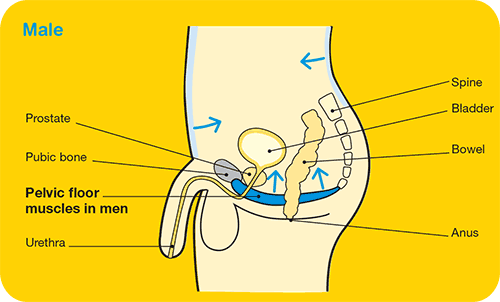
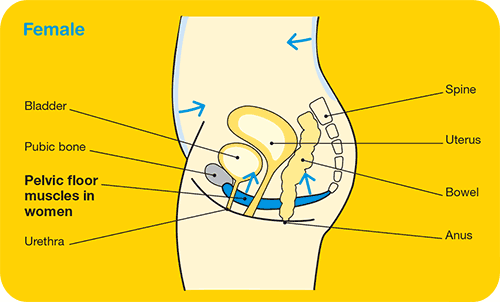
Your pelvic floor muscles span the bottom of your pelvis and support your bowel, bladder, and uterus for females.
A strong pelvic floor helps control urination (peeing) and bowel movements, sexual function, and stability of the abdomen (core) and spine.
Your pelvic floor can become weak due to age, childbirth, constipation, obesity, coughing a lot, heavy lifting, abdominal or pelvic surgery. Chemotherapy and hormone therapy can also impact the pelvic floor.
Seeing a pelvic floor expert
Continence nurses and pelvic floor physiotherapists can assess how your pelvic floor is working and tailor an exercise program to your needs.
Ask your doctor or specialist for a referral to a continence nurse or physiotherapist before doing pelvic floor exercises if you:
- have had recent pelvic or abdominal surgery
- have problems with urine or faeces (poo) leaking when coughing, sneezing, laughing or exercising
- often need to go to the toilet urgently
- have difficulty controlling bowel movements and wind
- feel like you haven’t fully emptied your bowel after bowel movements
- have dragging, heaviness or a bulge in the vagina
- experience a lack of sensation or pain during sex.
For suitable exercises, visit pelvicfloorfirst.org.au. To find a continence nurse or pelvic floor physiotherapist, call the National Continence Helpline on 1800 33 00 66 or visit continence.org.au.
You can search for a physiotherapist on the Australian Physiotherapy Association’s website.
Finding your pelvic floor muscles
Female
When you try to stop your urine stream for a couple of seconds while you are peeing, you use your pelvic floor muscles.
Another way is to feel the muscles you use when you imagine stopping the flow of urine and holding in wind.
Male
Imagine resting your scrotum on a plate, then contract the muscles that lift your scrotum off the plate.
Some cues to help turn on the pelvic floor muscles include trying to lift the scrotum up towards the tummy, trying to bring the base of the penis in towards the lower tummy and trying to stop as you’re doing a pee.
How to exercise your pelvic floor muscles
Pelvic floor exercises should be done several times a day. You can be standing, sitting or lying down. You can even do them while watching TV or waiting at traffic lights. The technique is the same for men and women.
- Start by relaxing all of your pelvic floor (including the muscles around the bottom) and your tummy (abdominal) muscles.
- Gently lift your pelvic floor muscles up and hold while you continue to breathe normally. Keep your upper abdominal muscles relaxed. Try to hold the contraction for up to 10 seconds (while breathing). Then relax your muscles slowly.
- Repeat the exercise up to 10 times. Rest and completely relax your pelvic floor muscles for 10–20 seconds between each set.
Safety tips
- Do not hold your breath.
- Do not tighten your tummy above the belly button. Focus on pulling up and holding onto urine and wind.
- Do not try too hard. You may end up contracting nearby muscles rather than the pelvic floor muscles themselves. Try changing positions if you can’t feel the pelvic floor muscles lifting and squeezing.
Exercise for People Living with Cancer
Download our Exercise for People Living with Cancer booklet to learn more and find support.
Download now Order for free